
The 50/30/20 Rule, the Zero-Based Budget, and the Envelope Method Compared

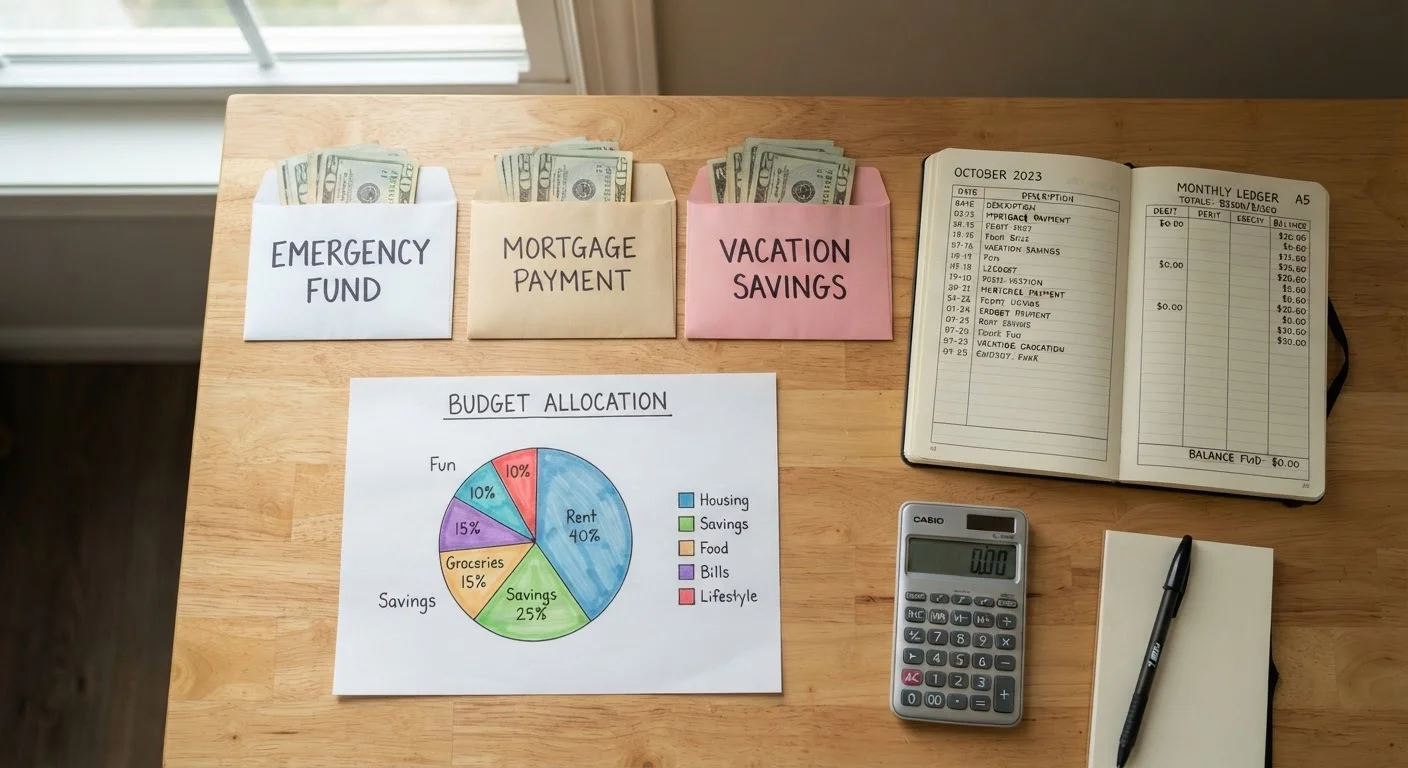
Photo: ArticleHood.com | Precision In Every Word editorial
Key Takeaways
- The 50/30/20 rule divides after-tax income into needs, wants, and savings using fixed percentage targets.
- Zero-based budgeting assigns every dollar a specific job, leaving zero unallocated at month's end.
- The envelope method uses physical or digital cash categories to cap discretionary spending.
- No single method suits everyone - your income stability and spending habits should guide your choice.
- Any structured budget is more effective than having no budget at all.
Why Your Budgeting Method Matters
A budget is only useful if you actually use it. That means the framework you choose has to fit your life - your income type, your spending habits, and how much mental bandwidth you're willing to give it each month. Three methods dominate personal finance conversations: the 50/30/20 rule, zero-based budgeting, and the envelope method. Each has a distinct philosophy and a different kind of person it serves best.
If you're just starting out, see our step-by-step guide to building your first budget before diving into which method to adopt. For a broader overview, the end-to-end personal budgeting resource covers everything from income mapping to handling setbacks.
| 50/30/20 Rule | Zero-Based Budget | Envelope Method | |
|---|---|---|---|
| Core principle | Split income into 3 percentage buckets | Assign every dollar a specific purpose | Cap spending with category envelopes |
| Tracking intensity | Low - broad category checks | High - detailed monthly allocation | Medium - per-category tracking |
| Best income type | Stable, predictable income | Variable or irregular income | Any income type |
| Setup time | Minutes to set up | 1-2 hours per month | Moderate initial setup |
| Flexibility | High - broad buckets allow movement | Moderate - requires replanning | Low - hard category caps |
| Best for | Beginners wanting simplicity | Detail-oriented planners and debt fighters | Habitual overspenders needing limits |
| Main limitation | May not fit high cost-of-living areas | Time-intensive to maintain monthly | Needs pairing with a broader framework |
The 50/30/20 Rule: Broad Buckets, Low Friction
Popularized by Senator Elizabeth Warren and her daughter in the book All Your Worth, the 50/30/20 rule splits your after-tax income into three categories:
- 50% to needs - rent or mortgage, utilities, groceries, minimum debt payments, insurance
- 30% to wants - dining out, subscriptions, hobbies, travel
- 20% to savings and extra debt repayment - emergency fund, retirement contributions, paying down balances faster
The appeal is simplicity. You don't track every transaction - you just check whether your spending broadly lands in the right buckets. This makes it sustainable for people who find detailed tracking exhausting.
The limitation is that the percentages assume a stable income and moderate cost of living. In high-cost cities, housing alone can exceed 50% of take-home pay, forcing tradeoffs that the rule doesn't address. It also offers limited guidance for those carrying significant debt.
Adjusting the Percentages to Fit Reality
Zero-Based Budgeting: Every Dollar Has a Job
Zero-based budgeting (ZBB) starts from a simple premise: income minus expenses should equal zero. That doesn't mean spending everything - savings, investments, and debt payments count as expenses. It means no dollar is left unassigned.
Each month, you list your expected income, then allocate every dollar to a specific category before the month begins. If your take-home pay is $3,800, your total budget allocations must also add up to $3,800. Anything unspent in a category gets consciously redirected - to savings, debt, or the next month's plan.
ZBB demands more time and attention than the 50/30/20 rule, but it rewards that effort with precision. It's especially effective for people with variable income (freelancers, commission-based workers) because it forces a fresh allocation each cycle based on actual expected earnings. It also shines when you're managing a very tight budget with little margin.
For a direct side-by-side of these two approaches, see zero-based budgeting vs. the 50/30/20 rule.
The Envelope Method: Spending Caps in Practice
The envelope method is the oldest of the three. Traditionally, you withdraw cash and divide it into labeled envelopes - one for groceries, one for gas, one for entertainment, and so on. When an envelope is empty, spending in that category stops for the month.
Its power lies in tangibility. Research in behavioral economics consistently finds that people spend more when paying with cards than with cash, partly because cash spending triggers a clearer psychological sense of loss. The envelope method exploits this instinct deliberately.
You don't have to use physical cash. Many people adopt a digital envelope system through budgeting apps that mimic the same structure - funding virtual envelopes at the start of each month and tracking spending against those caps in real time.
Don't Confuse Empty Envelopes With Financial Safety
The envelope method works best as a supplement to either of the other two frameworks rather than a standalone system. It addresses how you spend within categories but doesn't help you determine what those category amounts should be. Pairing it with the 50/30/20 rule or ZBB gives you both structure and a behavioral guardrail. For a thoughtful look at what rigid budgeting can and can't do, see the case for and against strict budgeting.
Choosing the Right Framework for You
The right budgeting method is ultimately the one you'll maintain consistently. Consider these factors:
- Income stability: Steady paycheck? The 50/30/20 rule is easy to implement. Irregular income? Zero-based budgeting adapts better month to month.
- Spending behavior: If you overspend in specific categories despite good intentions, envelope-style limits add a hard stop.
- Time investment: 50/30/20 takes the least ongoing effort; ZBB the most. Be honest about your bandwidth.
- Financial goals: Aggressive debt payoff or savings targets fit better inside a zero-based structure where every dollar is deliberately directed.
Your money mindset - how you relate to spending, saving, and financial planning emotionally - also plays a role. Someone who finds rigid tracking stressful may thrive with the broad flexibility of 50/30/20, while a detail-oriented planner may find ZBB satisfying rather than burdensome. Understanding your habits and attitudes toward money is part of finding a sustainable approach.
This article is for general informational and educational purposes only and does not constitute personalized financial advice. Consider consulting a licensed financial professional for guidance specific to your situation.
The content on this site is for informational purposes only and is not a substitute for professional advice. Always consult a qualified professional for guidance specific to your situation.