
Engineered Hardwood vs. Solid Hardwood Flooring: Which Holds Up Better Over Time

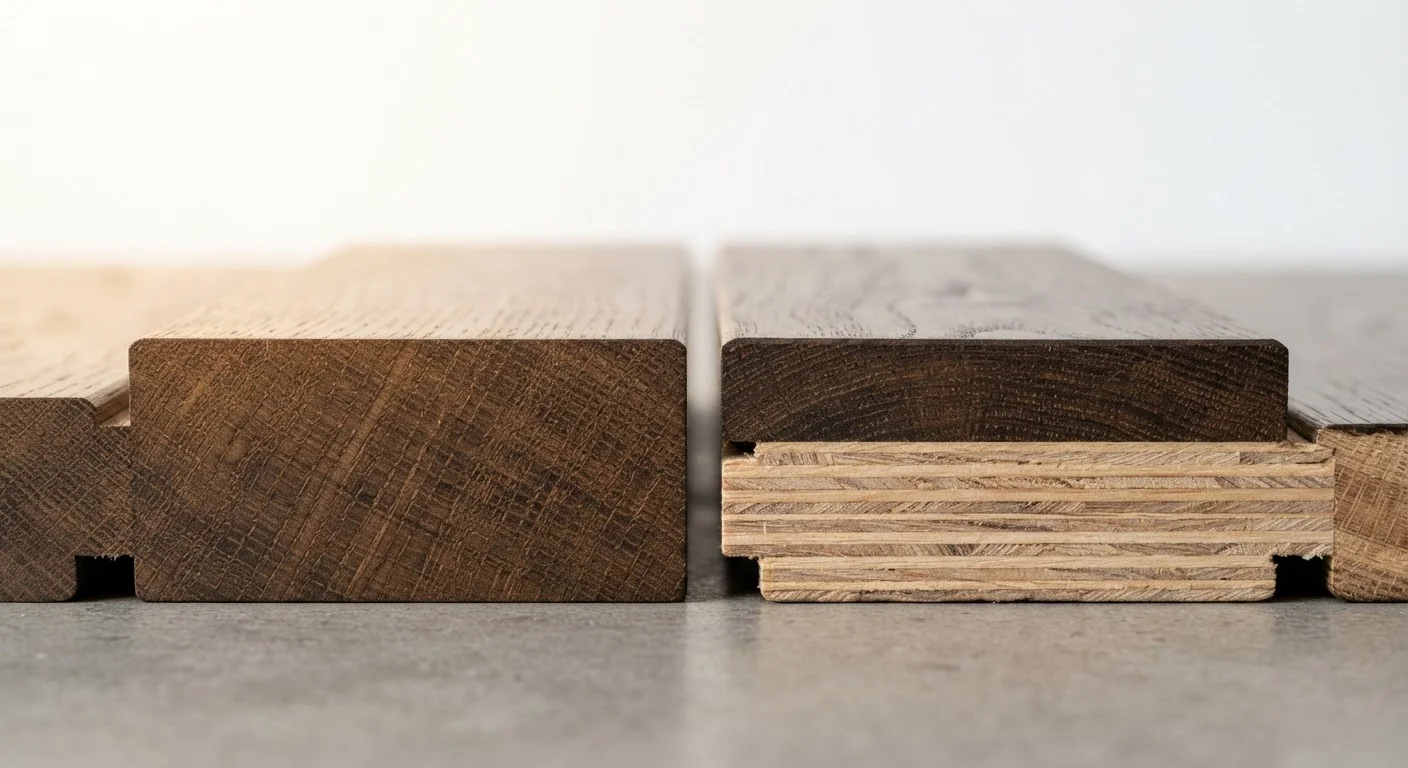
Photo: ArticleHood.com | Precision In Every Word editorial
Key Takeaways
- Solid hardwood can be sanded and refinished many more times than engineered hardwood, extending its lifespan in well-maintained spaces.
- Engineered hardwood's layered core resists moisture-related expansion and contraction far better than solid wood.
- Neither type is fully waterproof - standing water will damage both over time.
- Solid hardwood is limited to above-grade installations; engineered hardwood can go below grade.
- The visible wear layer on engineered hardwood determines how many refinishing cycles it can handle.
- Both options add comparable warmth and aesthetic appeal, but their long-term maintenance needs differ meaningfully.
What's Actually Inside Each Plank
The most important difference between these two flooring types isn't visible once they're installed - it's structural. Solid hardwood is exactly what it sounds like: a single, uniform piece of wood milled from one species, typically ¾ inch thick. Engineered hardwood, by contrast, is a sandwich construction - a real hardwood veneer on top, bonded to multiple layers of plywood or high-density fiberboard beneath.
This internal difference drives nearly every performance distinction between the two. Solid wood's single-piece construction means it responds as one unit to humidity and temperature changes - expanding when moist, contracting when dry. Engineered hardwood's cross-ply layers are oriented in alternating directions, which counteracts this movement and produces a far more dimensionally stable plank.
The top veneer on engineered hardwood is genuine wood - often the same species you'd find in solid planks - so the visual result is nearly identical. What varies is how thick that veneer is, which directly affects how many times the floor can be refinished. A thicker wear layer (3mm or more) allows two to three refinishing cycles; thinner veneers may allow only one, or none at all.
| Criterion | Engineered Hardwood | Solid Hardwood |
|---|---|---|
| Construction | Hardwood veneer over plywood core | Single solid wood plank |
| Typical thickness | 3/8" to 9/16" | 3/4" standard |
| Moisture resistance | Good - resists expansion/contraction | Poor - sensitive to humidity changes |
| Installation locations | Above, on, or below grade | Above grade only |
| Refinishing potential | 1-3 times (depends on veneer depth) | Many times over decades |
| Radiant heat compatibility | Generally compatible | Limited - check manufacturer specs |
| Expected lifespan | 25-40 years in good conditions | 50-100+ years with refinishing |
| Appearance | Real wood surface, nearly identical look | Full solid wood grain throughout |
Moisture, Humidity, and Where You Can Install
Moisture is the single biggest factor separating the two options in real-world performance. Solid hardwood is highly sensitive to humidity changes - in climates where indoor humidity fluctuates significantly between seasons, you can expect some degree of seasonal gapping in winter and slight swelling in summer. This is normal and manageable, but it places real limits on where solid hardwood can go.
Solid hardwood should only be installed at or above grade level (meaning on main floors or above). Installing it in a basement or on a concrete slab is generally not recommended because ground-adjacent concrete releases moisture vapor that solid planks cannot tolerate long-term.
Engineered hardwood is a fundamentally different story. Because its core layers resist moisture movement, it can be installed below grade, directly over concrete slabs (with appropriate moisture barriers), and in rooms with moderate humidity exposure like kitchens. It is still not waterproof - standing puddles or flooding will damage both types - but it handles everyday humidity swings with much greater tolerance.
Moisture Testing Is a Critical First Step
For any room where moisture is a concern, it's worth consulting a flooring professional before committing to either type. Proper subfloor preparation and moisture testing are critical steps that affect long-term performance regardless of which flooring you choose.
Just as choosing the right finish matters in other home improvement decisions - like selecting from paint finishes for different rooms - the installation environment should drive your flooring decision from the start.
Refinishing, Longevity, and Long-Term Value
Solid hardwood's greatest long-term advantage is its refinishing depth. Because the entire plank is solid wood, professional sanders can remove surface scratches, stains, and worn finish multiple times over the floor's life. A well-maintained solid hardwood floor can last 80 to 100 years or more. This refinishing potential is a meaningful factor for homeowners planning to stay long-term or who want a floor that can be restored rather than replaced.
Engineered hardwood's refinishing potential depends entirely on wear layer thickness. A floor with a 1mm veneer may not be safely sandable at all; one with a 4mm veneer can typically be refinished two or three times. Beyond that, replacement is the only option. That said, many modern engineered floors carry 25- to 30-year warranties, and in stable environments they perform well within that window.
¾ inch
Standard solid hardwood plank thickness
This depth allows professional sanding multiple times across decades, giving solid hardwood its long-term refinishing advantage over thinner engineered veneers.
3mm+
Wear layer thickness for refinishable engineered floors
Flooring industry guidance generally holds that engineered hardwood veneers of 3mm or more can support at least one professional refinishing cycle.
50-100 yrs
Potential lifespan of maintained solid hardwood
In stable, above-grade environments with periodic refinishing, solid hardwood floors are documented to last a century or more in residential settings.
For resale purposes, both options are generally regarded as desirable by homebuyers - significantly more so than laminate or vinyl alternatives. Solid hardwood carries a slight premium in buyer perception due to its refinishing longevity, but high-quality engineered hardwood in appropriate installations is widely accepted as a comparable upgrade.
Making the Right Call for Your Home
The decision really comes down to three questions: Where is the floor going? What are your local climate conditions? And how long do you plan to stay?
If you're installing in a main-floor living room or dining room in a climate-controlled home with stable humidity, solid hardwood offers unmatched longevity and refinishing potential. If you're finishing a basement, working on a concrete slab, living in a humid region, or installing over radiant heat, engineered hardwood is the more practical and often safer choice.
Neither option is universally superior - they're optimized for different conditions. Understanding those conditions in your specific home is what makes this decision manageable. When in doubt, a licensed flooring contractor can assess your subfloor, moisture levels, and installation context before you commit to either material.
The content on this site is for informational purposes only and is not a substitute for professional advice. Always consult a qualified professional for guidance specific to your situation.