
Buying vs. Leasing a Car: What Changes When You Do the Maths

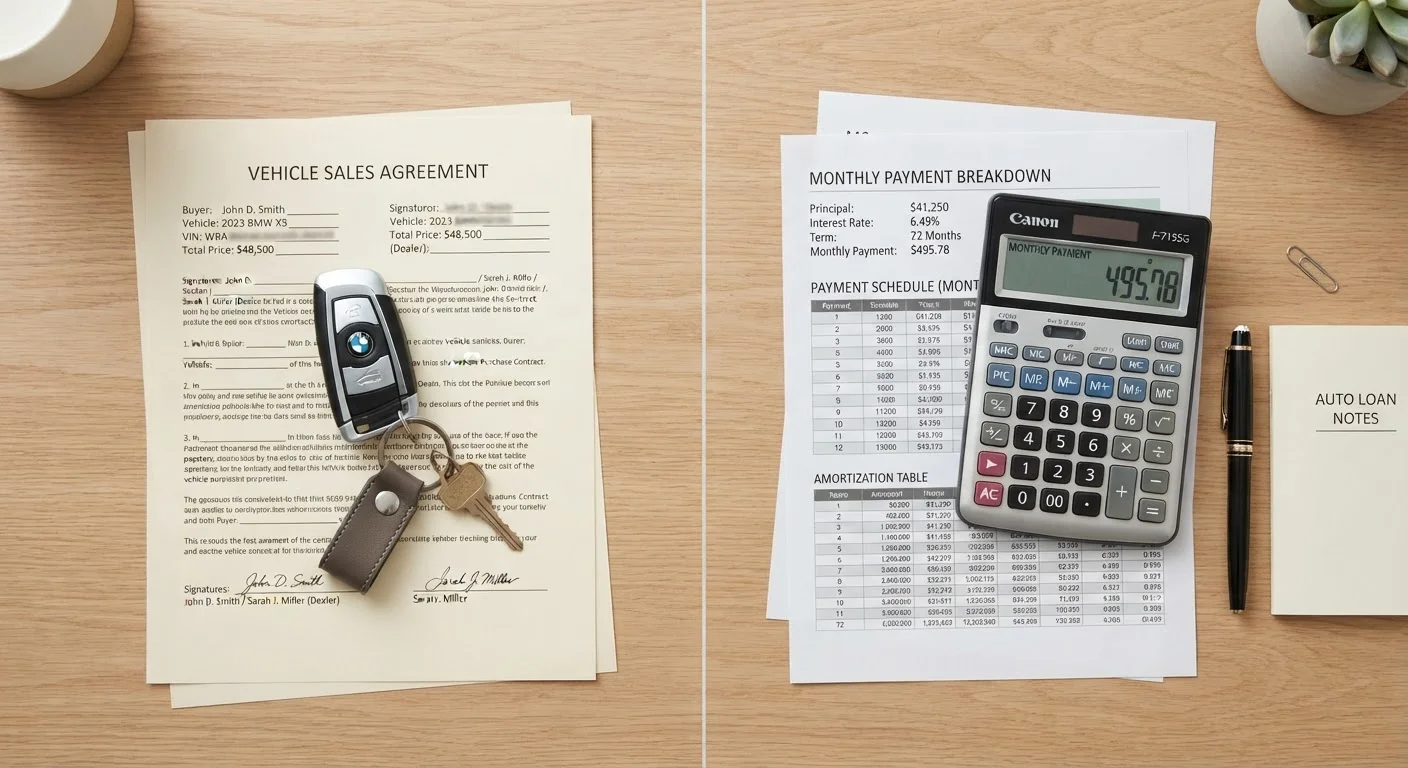
Photo: ArticleHood.com | Precision In Every Word editorial
Key Takeaways
- Buying builds equity over time; leasing builds none - you return the car when the term ends.
- Lease payments are typically lower month-to-month, but you pay indefinitely if you always lease.
- Mileage caps are a hard leasing constraint; exceeding them triggers per-mile overage fees.
- Financing a purchase means paying interest on the full vehicle price; leasing interest applies only to the depreciation portion.
- Total long-term cost usually favours buying, assuming you keep the vehicle well past loan payoff.
- Neither option suits everyone - your driving habits and financial situation determine the better fit.
How the Money Actually Flows in Each Scenario
When you finance a purchase, your lender pays the dealer the full vehicle price. You then repay the lender - principal plus interest - over a loan term, typically 48 to 72 months. At the end, you own the car outright. Every payment chips away at an asset that holds some residual value. That's equity, and it matters when you eventually sell or trade in.
When you lease, you're paying for the portion of the car's value you consume during the lease term - essentially the vehicle's projected depreciation. The leasing company (often the manufacturer's finance arm) retains ownership throughout. Your monthly payment is calculated from three variables: the capitalised cost (the agreed vehicle price), the residual value (what the car is projected to be worth at lease end), and the money factor (the interest-equivalent rate). Because you're only financing the gap between those two values, payments are lower on paper - but you have nothing to show for them when the lease expires.
For a fuller picture of what vehicle ownership actually costs beyond the monthly payment, see our breakdown of true ownership costs.
| Criterion | Buying | Leasing |
|---|---|---|
| Ownership | You own the car outright after loan payoff | Leasing company retains ownership throughout |
| Monthly payment | Higher - based on full vehicle price | Lower - based on depreciation only |
| Equity | Builds over time; car has resale value | None - payments yield no asset |
| Mileage limits | No limits | Typically 10,000-15,000 miles/year |
| Customisation | Permitted; your asset to modify | Restricted; must return in original condition |
| Early exit | Sell or pay off the loan | Early termination fees can be steep |
| Maintenance costs | Accumulate as vehicle ages | Usually covered under warranty during term |
| Long-term cost | Lower if vehicle kept past loan payoff | Higher if perpetually cycling leases |
Where Leasing Gets Complicated
Mileage limits are the most common leasing pitfall. Standard lease agreements allow 10,000 to 15,000 miles per year. Going over that ceiling - even by a few thousand miles - triggers per-mile charges typically ranging from $0.15 to $0.30. If you drive 20,000 miles annually on a 12,000-mile lease, the overage bill at turn-in can run into the thousands.
Wear-and-tear standards are another variable. Lessees are generally responsible for damage beyond what the leasing company defines as normal use. That definition can be narrower than most drivers expect - certain scratches, tire wear, or interior marks may result in charges at turn-in.
Early termination is expensive. Unlike a car loan - which you can pay off early or exit by selling the asset - breaking a lease mid-term typically means paying a substantial penalty, sometimes close to the remaining payment total. Flexibility costs real money in a lease structure.
$0.15-$0.30
Typical per-mile overage fee on a lease
Standard lease agreements published by major auto manufacturers' finance arms commonly cite this range for miles driven above the annual cap.
60-72 months
Average new-car loan term in the US
According to Experian's State of the Automotive Finance Market reports, the average loan term for new vehicles has extended significantly over the past decade.
~30%
Typical new-car depreciation in year one
Vehicle valuation guides such as Kelley Blue Book consistently note that many new vehicles lose a significant portion of their value within the first 12 months.
The Long-Term Arithmetic
Consider a simple thought experiment. You sign a 36-month lease, make all payments, and return the car. Then you lease again. Over 10 years, you've made 120 months of payments with no asset at the end. A buyer who financed a similar vehicle for 60 months and kept it for 10 years spent five years making payments - and then drove payment-free for five more, with a car worth something when they eventually sell.
The break-even calculation favours buying the longer you keep the vehicle. It can tilt toward leasing if you factor in that a purchased vehicle accumulates maintenance costs as it ages, while a leased vehicle is almost always under warranty. But that maintenance advantage shrinks if you're careful about upkeep and aren't replacing the car every three years regardless.
For a comprehensive look at acquisition, running costs, and eventual resale in one place, the full vehicle financial picture covers each stage in detail. And if you're weighing new versus used as part of this decision, new car vs. used car trade-offs is worth reviewing alongside this article.
Before You Sign Either Agreement
Whether you're buying or leasing, the contract details are where outcomes are made or broken. On a loan, the critical numbers are the interest rate (APR), total repayment amount, and whether there are prepayment penalties. On a lease, scrutinise the money factor, the residual value, the mileage cap, and the wear-and-tear policy. A lower monthly payment means nothing if the money factor is inflated or the mileage allowance doesn't match your actual driving.
It's also worth noting that neither path is free of budgeting considerations - both require realistic assessment of what you can sustain month to month and year to year, not just what looks manageable today.
Our pre-purchase checklist walks through the specific contract terms to verify before committing to any vehicle finance arrangement - useful for both buyers and lessees. And when your current vehicle eventually needs to go, private sale vs. dealer trade-in lays out your options honestly.
This article is for general informational purposes only and does not constitute personalised financial or legal advice. Consult a qualified financial professional before making major vehicle finance decisions.
The content on this site is for informational purposes only and is not a substitute for professional advice. Always consult a qualified professional for guidance specific to your situation.