
Bluetooth Versions: A Plain-Language Reference for Every Label You'll See

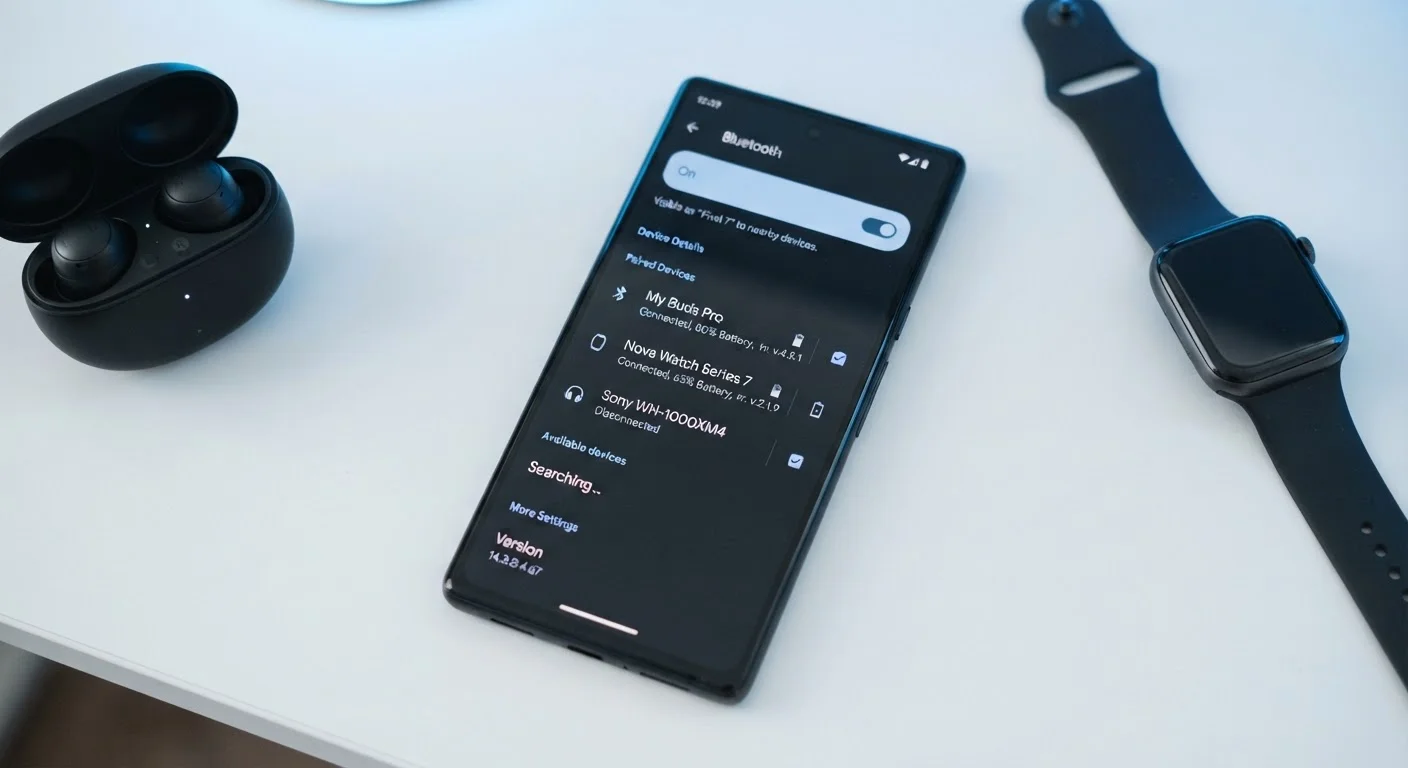
Photo: ArticleHood.com | Precision In Every Word editorial
What Bluetooth Versions Actually Represent
When you see "Bluetooth 5.3" on a product box or in a phone's spec sheet, that number refers to a specific revision of the Bluetooth standard - a set of rules that governs how devices find each other, connect, and exchange data. Each new version is defined by the Bluetooth Special Interest Group (SIG), an industry body that maintains the specification.
Version numbers do not tell you how fast your music will stream or guarantee a flawless connection. They describe which capabilities a device can support - actual performance still depends on antenna design, software, and what the other device in the pair supports. Think of it the way you might think about reading a spec label: the number sets a ceiling, not a floor. For a broader look at how spec labels work on consumer electronics, see our smartphone specs explainer.
| Governing body | Bluetooth Special Interest Group (Bluetooth SIG) |
| Current mainstream version | Bluetooth 5.3 (widely used in devices released after 2022) |
| LE Audio minimum requirement | Bluetooth 5.2 or later (Bluetooth SIG specification) |
| BLE first introduced | Bluetooth 4.0 (2010) |
| Backward compatible? | Yes - all versions connect with older versions |
| Operating frequency | 2.4 GHz ISM band (shared with Wi-Fi and other wireless devices) |
A Version-by-Version Breakdown
Here's what changed with each major version you're likely to encounter on devices sold today.
Bluetooth 4.0 - The Low Energy Revolution (2010)
Version 4.0 introduced Bluetooth Low Energy (BLE), a separate protocol optimized for small sensors - fitness trackers, heart rate monitors, proximity beacons - that transmit tiny amounts of data and need to run on coin-cell batteries for months or years. Classic Bluetooth (for audio and file transfer) continued alongside it.
Bluetooth 4.2 (2014)
Added stronger privacy protections, faster data throughput in BLE mode, and support for IPv6 connectivity - a stepping stone toward smart-home mesh networking.
Bluetooth 5.0 (2016)
The headline improvements were range (up to four times longer in open space versus 4.2) and broadcasting speed for BLE (up to twice as fast). Audio quality for traditional audio profiles did not change - the range gains apply mainly to low-energy connections like sensors and beacons, not headphones streaming music.
Bluetooth 5.1 and 5.2 (2019-2020)
5.1 added direction finding, letting compatible devices locate each other with centimeter-level accuracy - the foundation for asset-tracking tags. 5.2 introduced the LE Audio framework, including a new codec called LC3 (Low Complexity Communication Codec), lower power consumption, and the groundwork for Auracast broadcast audio.
Bluetooth 5.3 and 5.4 (2021-2023)
These refinements focused on connection reliability, reduced latency for LE Audio devices, and improved coexistence with other 2.4 GHz signals like Wi-Fi. If you see 5.3 on modern earbuds or phones, it mainly signals better stability rather than a dramatically new feature set.
Bluetooth SIG
The Bluetooth Special Interest Group is the industry consortium that owns and maintains the Bluetooth standard. It defines what each version number means and certifies products that carry the Bluetooth name.
BLE (Bluetooth Low Energy)
A power-optimized mode introduced in Bluetooth 4.0, designed for devices that send small amounts of data infrequently - like fitness sensors, smartwatch notifications, or location beacons. It runs alongside Classic Bluetooth.
LE Audio
A feature set built on Bluetooth 5.2 and later that uses the LC3 codec for more efficient audio transmission. It enables multi-stream audio, hearing aid support, and the Auracast broadcast feature.
LC3 Codec
The Low Complexity Communication Codec is the audio compression format at the core of LE Audio. It achieves audio quality comparable to older codecs at lower data rates, helping reduce power consumption.
Auracast
A Bluetooth SIG-branded broadcast mode within LE Audio that allows one transmitter to send audio to an unlimited number of receivers simultaneously, without individual pairing - similar in concept to a local radio broadcast.
Backward Compatibility
The ability of a newer Bluetooth device to connect with an older one. All Bluetooth versions maintain backward compatibility, though the connection only uses features both devices support.
LE Audio and Auracast: The Labels That Need Explaining
LE Audio is not a version number - it's a feature set that runs on Bluetooth 5.2 and later. It uses the LC3 codec to deliver comparable or better audio quality at lower bitrates than the older SBC codec, which translates to longer battery life on earbuds. LE Audio also enables multi-stream audio, letting left and right earbuds each receive their own independent stream rather than one bud relaying audio to the other.
Auracast is the branded name for LE Audio's broadcast mode. A single transmitter - a TV in an airport lounge, a PA system in a gym - can send audio to an unlimited number of nearby receivers simultaneously, without pairing. Think of it like a local FM radio station, but digital and private.
Hearing Aid Support Is a Key LE Audio Benefit
For related connectivity concepts and terminology, the Internet & Connectivity Glossary covers neighboring wireless topics worth bookmarking.
What the Label on Packaging Actually Tells You
When you see a Bluetooth version on a box, it confirms the highest version the device's radio hardware supports. A few practical points worth knowing:
- Backward compatibility: All Bluetooth versions are backward-compatible. A 5.3 device pairs with a 4.0 device; the connection simply uses whichever features both devices share.
- Audio codec is separate: High-quality audio codecs like aptX, aptX HD, AAC, or LC3 (LE Audio) are negotiated independently of the version number. Version 5.3 does not automatically mean better audio than 5.0.
- "Bluetooth" alone means Classic, BLE, or both: Most modern devices support both Classic Bluetooth and BLE. Some ultra-low-power accessories support BLE only - worth checking if you need to transfer files.
- Firmware can expand features: Some capabilities added in newer sub-versions can be delivered to existing hardware via a software or firmware update. Not all manufacturers push these updates; check the device's update history if you care about a specific feature.
Understanding firmware's role in expanding or limiting a device's declared spec is covered in more depth in our firmware and software explainer.
The content on this site is for informational purposes only and is not a substitute for professional advice. Always consult a qualified professional for guidance specific to your situation.