
What Food Labels Are Actually Telling You

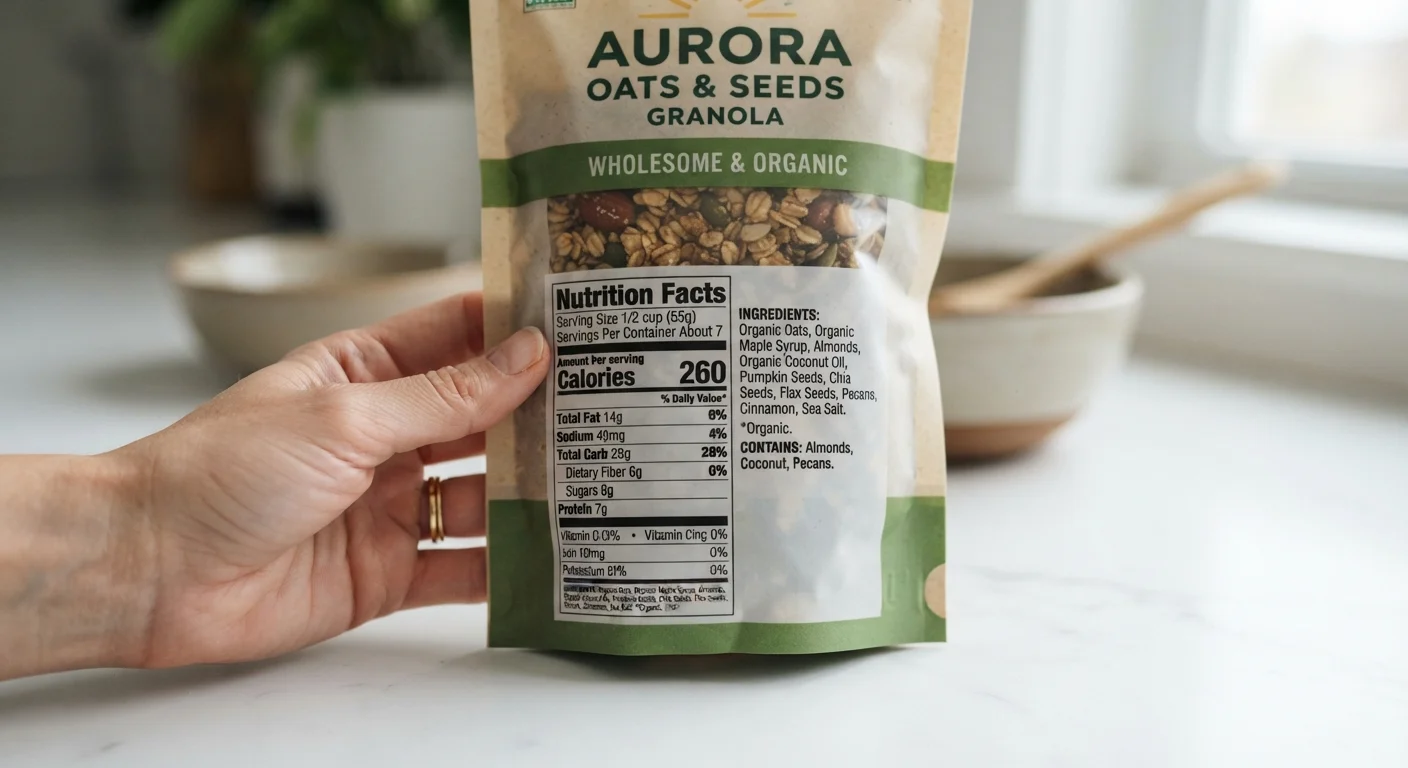
Photo: ArticleHood.com | Precision In Every Word editorial
Key Takeaways
- Serving sizes on labels reflect typical consumption amounts, not recommended portions - the two are different things.
- Ingredients are listed by weight, heaviest first, so order reveals a product's true composition.
- "Natural" is a loosely defined marketing term; "organic" and "gluten-free" carry enforceable federal standards.
- Percent Daily Values are based on a 2,000-calorie reference diet, which may not match your individual needs.
- Front-of-package claims are often marketing language - the Nutrition Facts panel and ingredient list are more reliable sources.
The Two Documents on Every Package
Every packaged food in the U.S. carries two distinct information systems: the Nutrition Facts panel and the ingredient list. They answer different questions. The Nutrition Facts panel tells you how much of key nutrients a food contains. The ingredient list tells you what the food is actually made of. Reading both - rather than just the front of the box - is where informed label reading begins.
The front of a package is, functionally, advertising space. Language like "multigrain," "light," or "made with real fruit" may be accurate in a narrow sense while being misleading in context. A cereal can be multigrain and still be mostly refined flour with added sugar. The Nutrition Facts panel and ingredient list are where the verifiable information lives. For a granular breakdown of the panel itself, see reading a nutrition label without getting lost in the numbers.
77%
Americans who check nutrition labels sometimes or always
According to a Food and Drug Administration consumer research report, a strong majority of shoppers consult the Nutrition Facts panel, though comprehension of specific elements varies widely.
20+ names
Different terms for added sugar found on ingredient lists
Nutrition researchers have catalogued over 60 names for sugar that can appear on ingredient lists, including syrups, juices, and chemical names like dextrose and maltose.
2,000 kcal
Daily calorie reference used for % Daily Value calculations
The FDA uses a 2,000-calorie reference diet as a standardized benchmark for %DV figures; individual calorie needs vary based on age, sex, activity level, and other factors.
Serving Size: The Number That Shapes Every Other Number
Everything in the Nutrition Facts panel - calories, fat, sodium, vitamins - is calculated per serving, not per package. So the first thing to check is the serving size and how many servings are in the container. If a bag of chips lists 150 calories per serving but contains 3 servings, eating the whole bag means consuming 450 calories.
The FDA updated serving size definitions in 2020 to better reflect how Americans actually eat, so some amounts shifted upward. But discrepancies between label servings and real-world eating habits still exist in many categories. Portion sizes and common assumptions explores this gap in more detail. Serving size confusion is also one of the most common sources of label misreading - a topic covered in depth in where consumers consistently go wrong with nutrition panels.
Quick Serving Size Check
Ingredient Lists: Order Is the Message
Ingredients must be listed in descending order by weight. The first ingredient is present in the greatest amount; the last is present in the least. This single rule reveals a great deal. If sugar is the first or second ingredient in a product marketed as a health food, that placement is meaningful - and worth noting.
One pattern worth recognizing: sugar can appear under many names - high-fructose corn syrup, cane juice, dextrose, maltose, and more. When a product contains several of these under different names, each ranks lower individually, even though their combined weight could place "sugar" at the top of the list. The Added Sugars line on the Nutrition Facts panel is specifically designed to capture this total. For a full walkthrough of naming conventions and ingredient list patterns, see reading an ingredient list without getting lost.
"Made With" Claims Can Be Misleading
Regulated Claims vs. Marketing Language
Not all label claims carry the same weight. Some terms have precise, enforceable federal definitions. Others are largely unregulated marketing language. Knowing the difference is one of the most practical consumer skills you can develop.
- "Organic" - Regulated by the USDA. Products must meet defined production standards covering pesticide use, soil management, and livestock practices.
- "Gluten-free" - Regulated by the FDA. Products must contain fewer than 20 parts per million of gluten.
- "Low sodium," "reduced fat," "high fiber" - These nutrient content claims must meet specific numeric thresholds set by the FDA.
- "Natural" - Not rigorously defined by the FDA. Its use is subject to ongoing policy discussion but currently carries no guaranteed nutritional standard.
- "Non-GMO" - Refers to genetic modification only; it says nothing about pesticide use or nutritional quality.
For a closer look at how organic, natural, and non-GMO differ in practice, see natural, organic, non-GMO: the differences that actually matter.
“The front of a food package is designed to sell the product. The back is where the regulated information lives. Learning to read the back is one of the most empowering things a consumer can do.”
— Marion Nestle, Professor Emerita of Nutrition, Food Studies, and Public Health, New York University
Putting It Together: A Practical Reading Approach
You don't need to analyze every label exhaustively. A practical approach: start with the serving size to orient yourself, scan the Nutrition Facts for the nutrients most relevant to your goals (calories, sodium, saturated fat, fiber, added sugars are common reference points), then check the first five ingredients to understand what the product is fundamentally made of.
Keep in mind that calorie counts are estimates - the Atwater system used to calculate food energy has known limitations. Why calorie counts on labels are always approximate explains why the number printed is never perfectly exact. Labels are tools for comparison and general awareness, not precise dietary prescriptions. Combined with an understanding of whole foods versus processed foods on the spectrum, reading labels becomes one part of a broader, more confident approach to eating.
This article is for general informational and educational purposes only. It is not intended as medical or dietary advice. Consult a registered dietitian or qualified healthcare professional for guidance tailored to your individual health needs.
Frequently Asked Questions
The content on this site is for informational purposes only and is not a substitute for professional advice. Always consult a qualified professional for guidance specific to your situation.